




In our first post, we learned that peptides are short chains of amino acids and that many peptides can act like biological messages in the body.
But how does that message actually work?
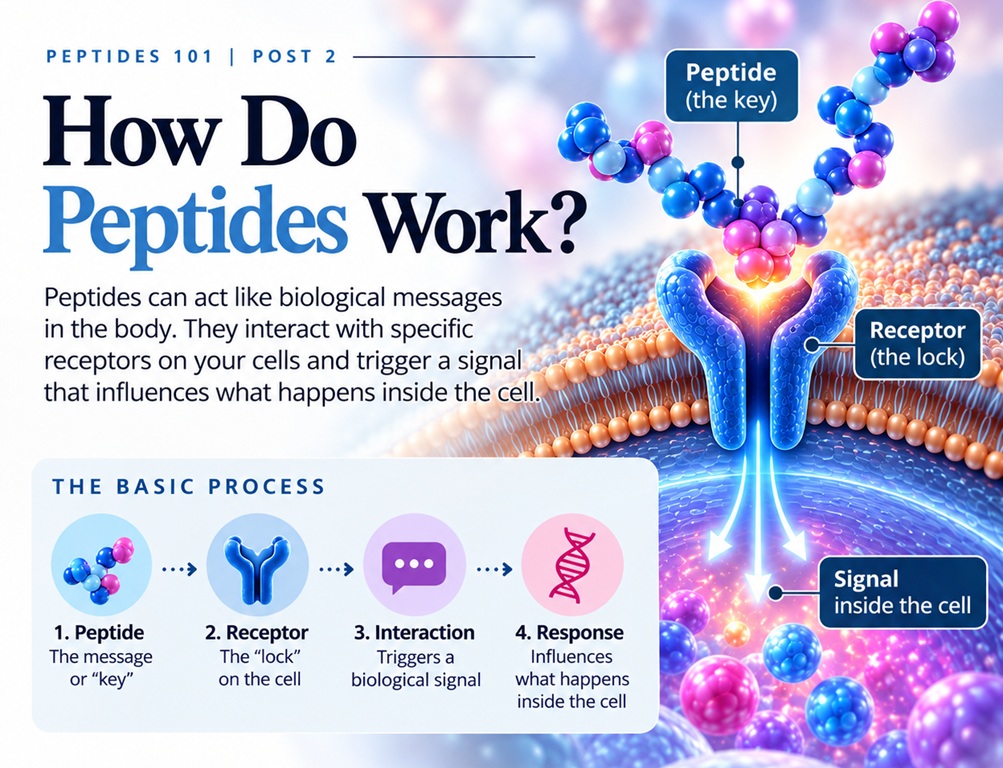
Think of some of the receptors on your cells as locks.
Certain peptides can interact with specific receptors—similar to how a key fits into a lock.
When the right peptide interacts with the right receptor, it can trigger a signal that influences what happens inside the cell.
Depending on the specific peptide and receptor involved, that signaling may influence processes related to:
• Metabolism and appetite
• Hormone signaling
• Blood-sugar regulation
• Growth and development
• Digestion
• Reproductive functions
• Skin and tissue processes
• Immune and cellular activity
But here is the most important point:
Not all peptides do the same thing.
One peptide may influence appetite signaling.
Another may affect hormone-related pathways.
Another may be involved in glucose regulation.
And another may interact with completely different biological processes.
That’s why saying “peptides do this…” can be misleading.
A better question is:
Which peptide—and which receptor or pathway does it affect?
And remember: just because a peptide produces a biological effect does not automatically mean it has been proven safe or effective as a medical treatment.
Some peptide-based medications have extensive clinical research and FDA approval for specific indications. Others are still being studied or have limited human safety and effectiveness data.
The takeaway:
Peptide = the message or “key”
Receptor = the “lock”
Interaction = a biological signal
Result = depends on the specific peptide and pathway
Understanding this basic concept will make the rest of our peptide series much easier to follow.
Next: Peptides vs. Proteins — What’s the Difference?
Education Before Treatment.